

Will AI Replace Customer Service or Take Only Part of It
.
AI will not take over your customer service team. The technology answers the calls your staff members miss, and nothing more.
You want a clear answer to a question many leaders ask right now. AI will not take over your customer service team. The technology answers the calls your staff members miss, and nothing more.
Key Takeaways
- AI will not replace your customer service team; it answers the calls they miss.
- Industry reports tie missed calls to lost revenue.
- AI answers at scale; your team keeps the work worth their time.
- Slow follow-up loses the sale, the referrals, and the repeat work for years.
- The choice is answered versus lost, not people against machines.
What AI Replaces and What It Does Not
Many leaders fear a machine will take every customer conversation and replace the human staff. The real picture looks very different.
AI handles the calls nobody answers, like the ones ringing at 9 p.m. or during a lunch rush. Your staff still manages the complex, high-value conversations.
A service like Callvera.ai shows the split in practice. The AI answers the missed call, captures the lead, and books the job. A human steps in for anything needing judgment or a personal touch.
The split raises an obvious money question for every owner. Keep reading to see what missed calls truly cost.
The Real Cost of Missed Calls
Missed calls are not a small annoyance. Industry reports connect them to real lost money.
First, look at how many calls never reach a person.
- BrightLocal found 62% of first-attempt inbound calls to small businesses go unanswered.
- CallRail analyzed 11.5 million inbound business calls and measured a 28% to 31% miss rate (July 2026).
- Home-service contractors miss 27% to 62% of calls, with on-site field crews at the high end.
Each missed service call has a dollar value too.
- BIA Advisory Services and Invoca put the average missed service call at $1,200.
- Long-term customer lifetime value reaches $5,000 to $15,000, far beyond one ticket.
A voicemail greeting commonly ends the contact.
- Hiya reports 80% of callers refuse to leave a voicemail, and 87% for people under 45.
- 85% of missed calls become permanently lost customer opportunities.
The yearly total adds up fast for a business of any size.
- Dialora puts the average U.S. small-business loss at $126,000 a year (updated 2026).
- A micro-business missing 2 calls each weekday loses over $9,000 a year (Ambs Call Center).
- A mid-sized plumbing practice loses $18,000 to $234,000 a year (CallJolt).
- A mid-sized HVAC practice shows $45,000 to $252,000 in yearly losses (CallJolt).
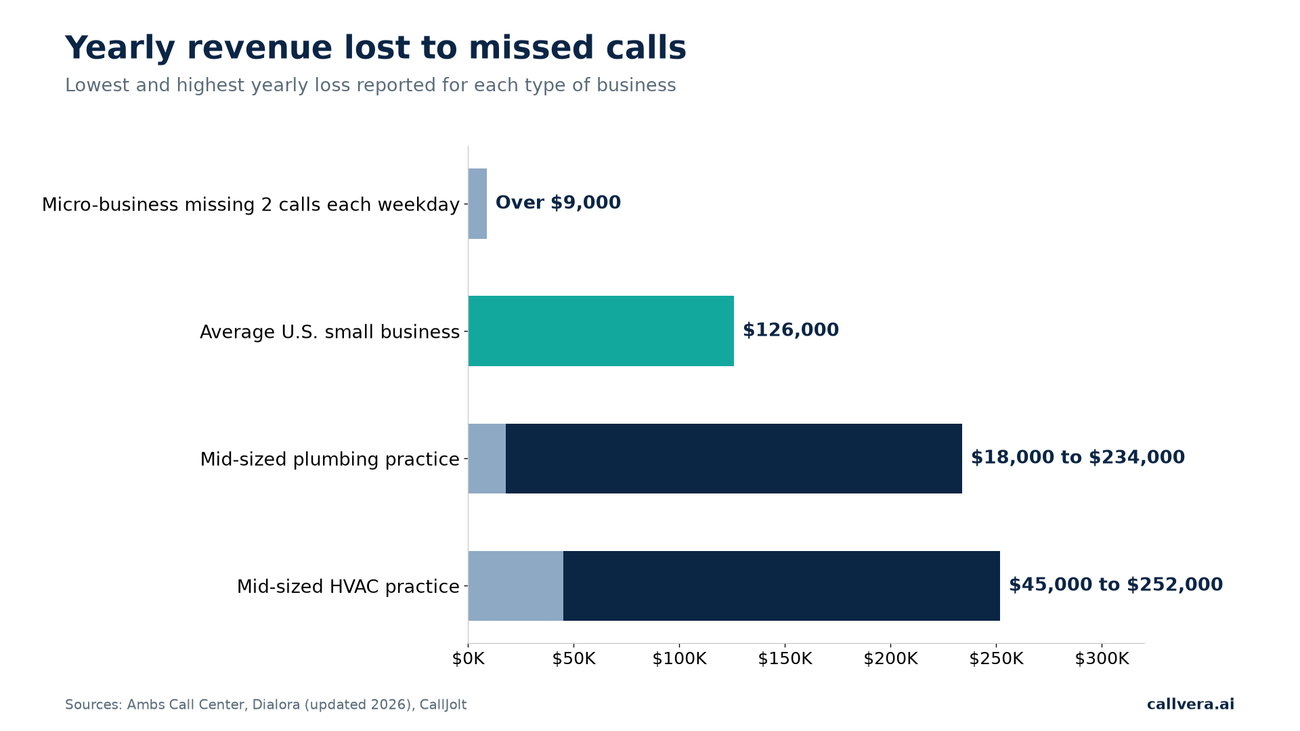
The worst part comes next. A missed caller will not wait for you. Nextiva and CallRevu found 62% to 82% of abandoned callers phone a rival at once.
The data points to one obvious fix. Read on to see what AI handles and what your team keeps.
AI for Volume, People for Value
Human teams have a hard limit. No person can answer phones in every market, day and night, with no break.
AI covers the full volume, hour by hour. The system answers the first ring at 3 a.m. and the tenth call during an evening rush.
Your staff members then focus on the work worth their skill, like:
- A tricky complaint, where careful handling matters.
- A large contract where a real person should close the deal.
- A loyal client who wants a real conversation.
The split works even as call volume grows. Automated resolution rates differ by industry, based on task complexity and data access.
- Telecom bots settle 40% to 60% of routine contacts alone (aissist).
- Banking and finance reach 60% to 75.2%, led by balance checks (fin.ai).
- Retail and e-commerce top the group at 55% to 84% (Comm100).
- Healthcare records 40% to 60%, limited by strict compliance rules (notch.cx).
- Franchise and local service rates are not uniformly aggregated yet (getnextphone).
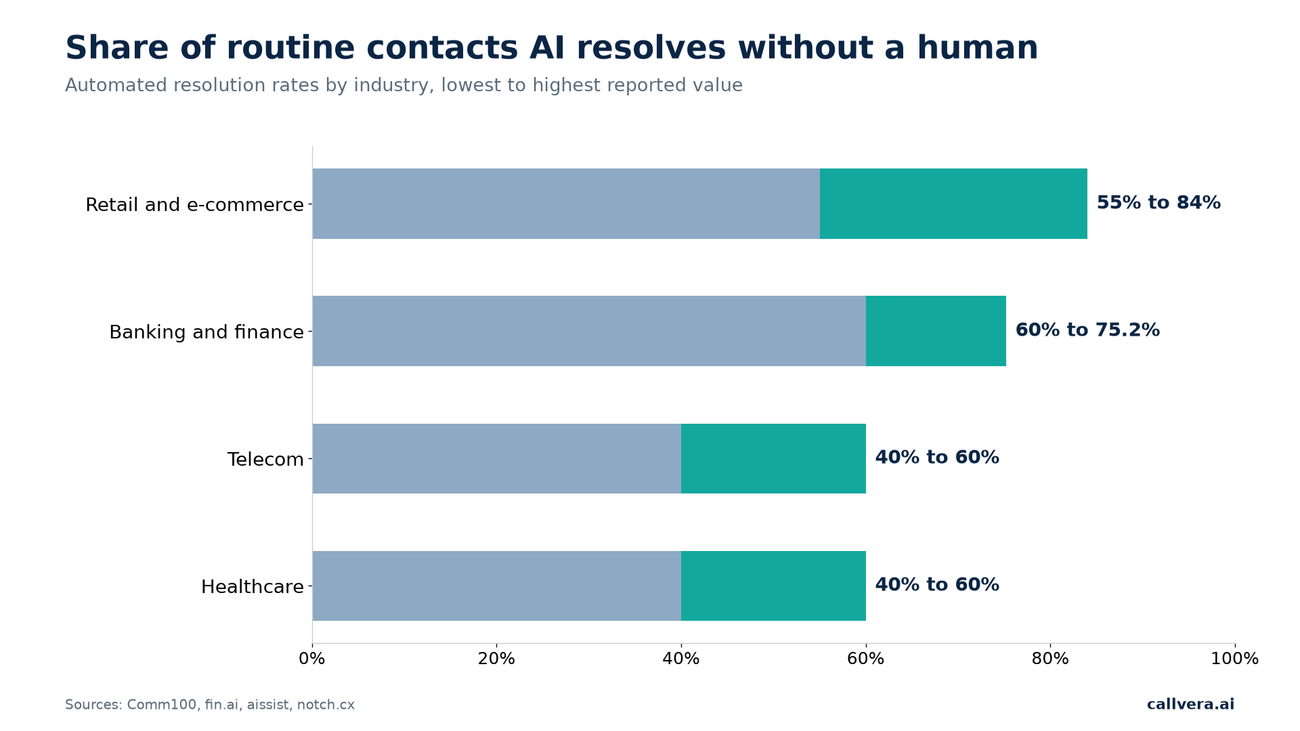
AI absorbs the routine volume; people handle the rest.
Speed decides what comes next. A slow reply costs more than a missed ring. Read on to see the real penalty for waiting.
Why Slow Follow-Up Costs You for Years
A slow reply does more damage than one lost sale. The harm grows for years.
One missed follow-up costs far more than a single job:
- The first sale, gone before a rival even answers the phone.
- Repeat work a happy customer would bring back for years.
- Referrals and reviews a loyal customer gives to friends.
Response speed shapes the result more than most leaders expect. Industry data attaches hard numbers to the long-term loss.
- The average business loses $127,000 a year in compounding revenue from slow follow-up (leadresponse.co).
- Weak persistence and late replies waste 70% to 80% of total lifecycle revenue (Martal Group).
- Referral leads convert at a premium 30% to 40%, the warmest lead category (Setterly).
- Poor execution wastes 71% to 73% of all internet-generated leads (trysidekick).
Nearly half of salespeople, 48%, stop after a single follow-up attempt (Martal Group).
The fix is not complicated. Answer fast, every single time.
The lost revenue then stops. Keep reading for the simplest way to frame the choice.
Answered or Lost, Not People Against Machines
The question contains a false choice. Your business either answers a lead or loses it, with no middle ground.
One poor experience ends many customer relationships for good:
- PwC found 52% of consumers quit a brand after one bad experience.
- A separate PwC study of 15,000 people in 12 countries put the walk-away rate at 32%.
- SurveyMonkey reports 57% stop doing business with a company after poor service.
- Only 1 unhappy customer in 26 complains; the other 25 leave without a word.
Speed changes the result more than price or brand:
- MIT and Harvard research shows conversion odds drop 400% for every 10-minute delay.
- A reply inside 5 minutes connects 100 times better than one sent after an hour.
- Velocify found a 391% conversion lift for a reply within 60 seconds.
- The speed edge fades fast: +160% at 2 minutes, then +62% by the half-hour mark.
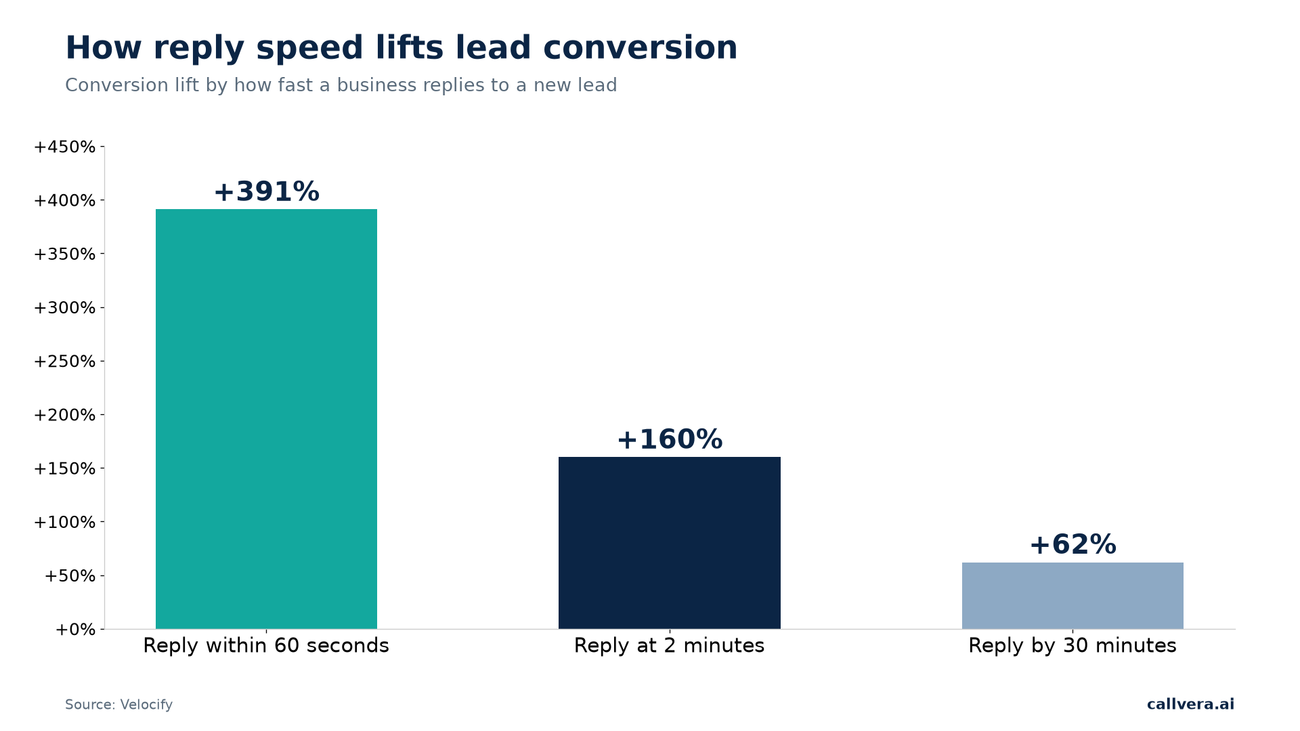
The business to reply first almost always wins the customer:
- 78% of consumers buy from the very first company to respond to them.
- The National Association of Realtors found 74% of buyers interview only one provider.
- Zillow reports 47% of consumers hire the first agent they speak with.
AI makes the answered side realistic at any hour. Production bots resolve a large share of contacts with no human agent.
- Gartner data shows deployed support AI handles 40% to 55% of contacts without a human.
- Mature, well-tuned bots reach 70% to 80% on tasks like booking and account updates.
The pattern repeats in every study above. Fast answers keep customers. Slow replies lose them for good.
The Smart Way to Add AI
The answer to the big question is simple. AI will not replace your customer service team. Human teams keep the hard calls; AI takes the overflow.
Callvera.ai builds the answered side for multi-location businesses and franchise brands. The AI answers missed calls, captures leads, and reactivates old ones. Human staff take over the moment judgment matters.
The rollout is low-risk for a cautious leader.
- Start with one to three locations.
- Test the AI enterprise-wide before a full commitment.
- Roll it out without complicating your current software tools.
You keep your people, the tools, and the daily routine already in place. AI just covers the calls slipping past the team today.
Ready to see fast answers at your locations? Book a call with the Callvera.ai team: https://callvera.ai/book-a-call
Questions answered